

Bloomberg: 90,000 London Jobs Are Heading to the Regions – What It Means for Property Investors

London's white-collar workforce is increasingly heading north, with the North West and Midlands set to gain the most.
The number is striking, but the logic behind it is even more so. Around 90,000 white-collar jobs currently based in London – lawyers, bankers, analysts, consultants – are expected to relocate to other parts of the UK over the next five years.
The estimate comes from recruitment firm Robert Walters, whose analysis draws on past job movement data from major employers, LinkedIn talent flow data, and office capacity figures across the regions. Bloomberg reported the findings in August 2026, and the picture they paint is one of a structural economic rebalancing that has been building quietly for years and is now accelerating with significant policy backing behind it.
Where the Jobs Are Going
The North West is set to be the single biggest beneficiary of the shift, with Robert Walters estimating it could absorb between 15,000 and 22,500 roles – roughly a quarter of the total – as businesses drawn by lower operating costs and a growing professional talent pool expand their presence in Manchester and the surrounding area.
The Midlands follows, taking around 20% of relocations (between 12,000 and 18,000 jobs), with Birmingham at the centre of that movement.
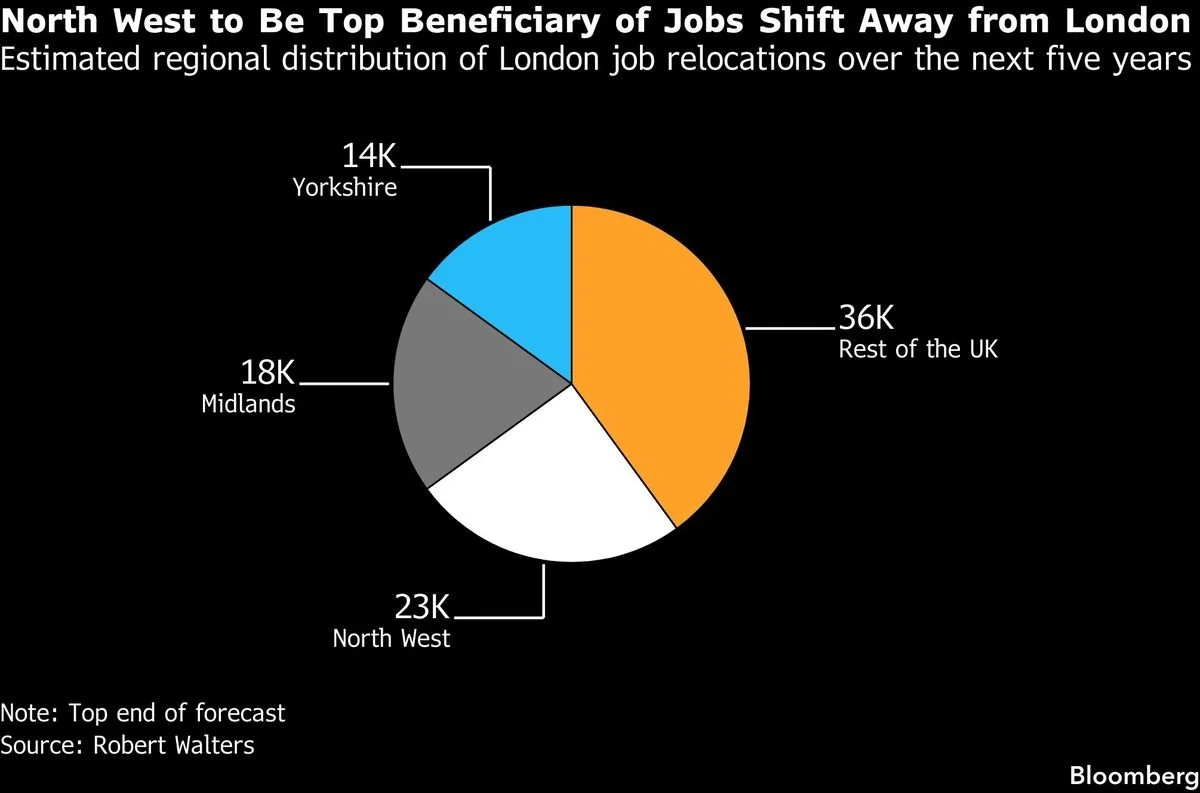
Source: Robert Walters, via Bloomberg, August 2026.
From Deloitte to Goldman Sachs, major professional services firms have already established and grown regional hubs in Birmingham and Manchester over the past decade, responding to cost pressures and the talent available outside the capital. The Bank of England is targeting approximately 10% of its workforce based in Leeds within the next year. The direction of travel is already visible in the hiring data – Robert Walters and other recruitment platforms have seen activity accelerate consistently outside London – and the pipeline of roles expected to follow is substantial.
The Policy Engine Behind It
What makes the current moment different from previous cycles of regional optimism is the political context.
Prime Minister Andy Burnham has made economic devolution a central objective of his government, framing it as a push to deliver what he describes as "growth in every postcode." In a pointed signal of intent, his administration has established No. 10 North – an outpost of the Prime Minister's office based in Manchester – and has committed to giving regional governments greater control over locally raised revenue.
Britain currently controls only 5% of taxes and 20% of spending decisions at a local level, making it the most fiscally centralised country among the OECD's 38 members. Burnham has said explicitly that he intends to change that. If regional governments gain meaningful control ov⁸er their own economic levers, the case for businesses to base operations closer to those decision-makers – and to the talent pools those regions are cultivating – becomes considerably stronger.
A Population Shift Already Underway
The jobs data does not exist in isolation. London's population fell last year for the first time since the 1980s, when excluding the pandemic period. People are leaving – and the pattern of where they are going maps closely onto where the employment growth is heading.
Scotland, Birmingham, Brighton and Bristol were amongst the most popular destinations for London leavers, with the trend most pronounced amongst families with children, who tend to follow employment opportunity, rather than lifestyle preference when making a permanent move.
Separately, HR platform Employment Hero found that payrolls at small and medium-sized businesses in the north of England grew 6.3% quarter-on-quarter in July – roughly twice the rate recorded in London over the same period. The acceleration is not confined to large corporate relocations.
The Financial Weight of the Shift
Robert Walters estimates that the relocation of roles from London will transfer as much as £9 billion of employer spending to regional cities over the next five years. When the knock-on effects into local property markets and businesses are included, that figure rises to £15 billion by 2031, with the North West and Midlands absorbing the largest individual shares.
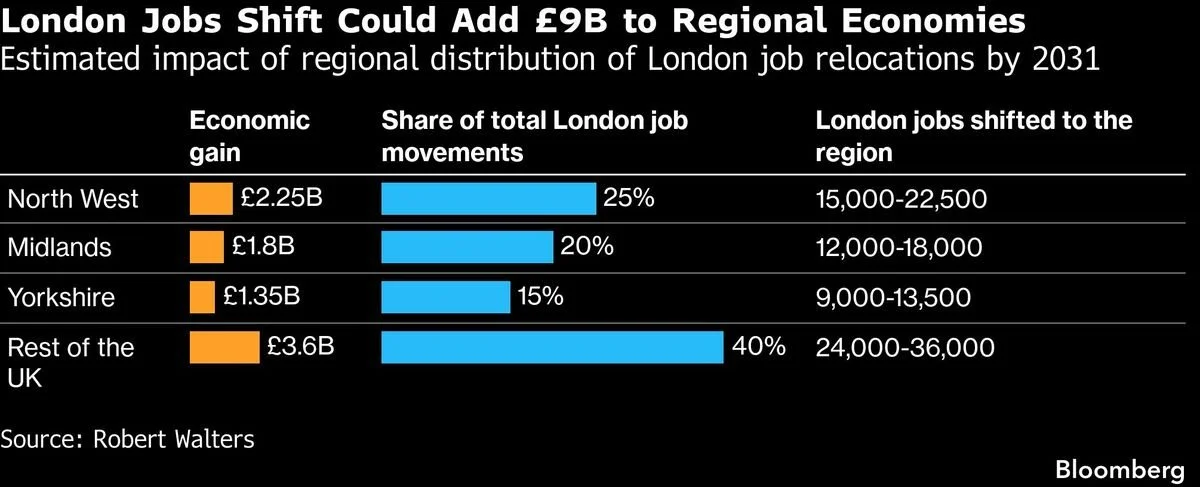
Source: Robert Walters, via Bloomberg, August 2026.
To put that in context: £2.25 billion of additional employer spending landing across the North West – with Manchester as its main anchor – and £1.8 billion in the Midlands, over five years, does not stay in corporate accounts. It flows into salaries, into local services, and – critically for anyone looking at residential property – into rental demand from a professional workforce that needs somewhere to live.
What This Means If You're Invested in UK Regional Property
A relocating firm does not just move a job. It moves a tenant – typically a well-paid, stable one – into a city where rents and entry prices remain substantially below London, and where the supply of quality city-centre housing is already constrained. That combination is precisely what underpins the investment case for cities such as Birmingham and Manchester that On Invest has been building around and forging strong relationships with top-tier developers.
The professionals arriving in these cities are not looking for budget accommodation. They are the kind of tenants who rent quality apartments in well-connected city-centre locations – the same locations where On Invest's clients are already positioned, in developments including Priors Gate in Birmingham and our Manchester portfolio. Regional rental demand was already strong before this data was published. If even a proportion of the Robert Walters forecast materialises, it adds a further and quite specific layer of structural support to the markets we focus on.
For investors looking at UK property from across Asia and the Middle East, the headline is straightforward: the employment geography of the United Kingdom is shifting, government policy is accelerating that shift, and the cities positioned to benefit most – Manchester and Birmingham – are the same ones where yields, entry prices and supply constraints make the investment fundamentals most compelling.
If you would like to understand how this translates to specific opportunities currently available through On Invest, get in touch with our team.
Source: Bloomberg (Irina Anghel), August 2026.